http://nextbookpress.com/books/347/?utm_source=Tablet+Magazine+List&utm_campaign=20d0e1714b-7_19_2011&utm_medium=email
This link will take you to the home page of the amazing story of scholarship on the medieval Jewish community in Cairo. Adina Hoffman and Peter Cole's book, "Sacred Trash: the Lost and Found World of the Cairo Geniza" is a must read for all students interested in what academic research is all about, whether you're interested in poetry and literature, biblical studies, history, commerce, academics.... This link will also take you to a short video about the book. Superb!
Tuesday, July 19, 2011


Tuesday, June 7, 2011
Leslie Stahl on The City of David, on CBS 60 Minutes
http://www.cbsnews.com/video/watch/?id=7368462n&tag=mg%3Bmostpopvideo%3Ftag%3Dfacebook
Tuesday, May 17, 2011
Book Review: I Shall Not Hate
Justin Dalrymple
Muslim/Jewish/Christian Relations
Professor Judith Rood
Book Review #3: I Shall Not Hate
Word Count: 877
I Shall Not Hate
Izzeldin Abuelaish is my hero. I read I Shall Not Hate a few weeks ago and a bit more than 24 hours after I had picked it up, I had finished it. However, I needed time to process its contents and decided to wait a short time before writing my review. This book has had a tremendous and profound effect upon me. Now, whenever anybody mentions the Israeli/Palestinian conflict or the Arab/Israeli conflict, Izzeldin Abuelaish comes immediately to mind. His story sticks out in the midst of these conflicts like salt in an open wound. I cannot imagine how any man could go through so much pain and turmoil, and yet, though he would have the right more than any other man, he cannot hate. Or maybe more precisely, will not hate. A modern day Job, as he refers to himself, this man has denied his rights to hate for the benefits of him, his family, his people, and Israelis. Izzeldin Abuelaish, a Palestinian refugee from the Gaza Strip, a doctor, and a Muslim should be a model for anyone who wishes to overcome severe adversity and who wishes to co-exist peacefully with their enemies.
As I mentioned above, Izzeldin Abuelaish is a Palestinian from the Gaza Strip with an incredible story. He was born among a Muslim family in the Jabalia refugee camp in Gaza. His family, the Abuelaish’s, left their homes during the 1948 war with Israel to avoid the fighting, expecting to return a few weeks, or at the latest, months. However, the weeks became months, and months became years, but they were still unable to return. Izzeldin remarks that he still has the deed to their land.
This was just one of the numerous hardships that affected Izzeldin and his family. Growing up Izzeldin tells of the difficulties that he faced living in the Jabalia refugee camp. He, his many siblings, and parents lived in a small single room house. They were extremely poor, and while Izzeldin was just a child, his mother would wake him up very early in the morning to take food to the market to sell just to earn a little money. This meant that he was extremely tired when it came time to go to school. The lack of adequate rest and the stress of waking up early to work and still do well in school took its toll on his body. A few years later, he said, he developed severe arthritis in his knees.
It would’ve been easy for Izzeldin to give up and allow these difficulties to overcome him. Yet, he saw a way to overcome his hardships through education. He was a brilliant student and his parents pushed him very hard to earn good grades. Despite the lack of sleep, he put in a lot of hard work and ultimately managed to get top grades in class. This was often the result of staying up until late hours of night doing homework in a corner by firelight with a blanket up to prevent the light from flooding on his sleeping siblings and parents.
As a result of his good grades he earned scholarships to study medicine in Cairo. He was the first in his family to attend university, and after a few years, the first to become a doctor. Immediately afterward he began searching for jobs and ended up accepting a job working in an Israeli hospital. This meant traveling and crossing the checkpoints between Gaza and Israel. These were always a painful process since they were sometimes closed with no warning which left him stuck on one side or the other. He, also, often had to spend a whole day just to get through.
As you can see Izzeldin had a rough life and things began to get a lot worse for him when his wife, Nadia, died suddenly from acute leukemia. His tribulations climaxed on the evening of January 16, 2008. During the Israeli invasion of Gaza tanks came down the road that their house was on. While he, his children, and his niece were inside, one of the tanks parked outside and aimed at his house. Frightened, Izzeldin called one of his media contacts in Israel and warned him what was happening. His friend called the IDF and told them who was inside the house that they were targeting. The IDF assured Izzeldin’s friend that they would leave. They did not, however, and a little while later they opened fire. The three blasts struck one of the rooms of his house where his three daughters and niece were hiding. None of them survived.
Yet, Izzeldin Abuelaish stands by his resolution to never hate. I’m not sure I could ever say I could do the same. I hope and pray that I would be able to, but I’m not sure I could. This is why I admire Izzeldin so much—the strength that he shows in his will not to hate is greater than I could ever imagine. I admire his strength, courage, and bravery, and I pray that God would give others in similar situations the ability to do the same.
Wednesday, May 11, 2011
Insider Movement and the Christian Witness
A freshman came in to talk with me today about his plans to go to the WB for the summer. The plan is to live in a refugee camp with friends of the family who are serving with Fs in a tough neighborhood outside of the city of David's birth. As he told me the plan, I grew increasingly alarmed, and I realized that the insider strategy followed by some organizations is really a bad idea in a place as saturated with missionaries and as politicized as a refugee camp on the WB.
As I spoke with this student, I emphasized that this strategy actually weakens our witness. By criticizing other Christians for not evangelizing, by failing to support believers--both indigenous and from non-Christian backgrounds, we are not supporting our brothers and sisters in the faith. Our students should be able to work with Christian groups in places like the WB where there are evangelical Christians. If they do not, and instead go "underground" they open up the body to suspicion and doubt. Dissimulation is a strategy necessitated only where it is truly dangerous to openly identify oneself as a Christian. This is not the case in the Holy Land.
Hear more about this today in the SMU office from 3-7, and the debate in the Collegium from 7-9 between Jeff Morton and Carl Medieras.
Sunday, May 8, 2011
The Crucifixion and the Qur'an
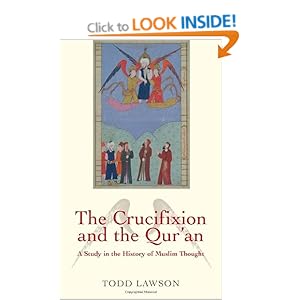
While the Qur’an denies Jesus’ divinity in unambiguous terms more than thirty times, the denial of Jesus’ crucifixion is based on a single ambiguous phrase, shubbiha lahum, which occurs only once, in Sura Al-Nisa’ (4) Ayat 157. Ironically, the root ‘sh-b-h’ appears in Surat Al-‘Imran (3) Ayat 7 warning that since only God knows the meaning of the ambiguous verses, it is irreverent to interpret them. Today’s commonly held interpretation is that shubbiha lahum means that God placed Jesus’ likeness on Judas Iscariot which confused the Jews into crucifying Judas
instead of Jesus. Most people familiar with the topic understand that the Qur’an denies Jesus’ crucifixion. My review of Todd Lawson's interesting book was published in the January issue of The Muslim World Journal and can be accessed at: http://onlinelibrary.wiley.com/doi/ 10.1111/j.1478-1913.2010.01347.x/abstract then click 'get PDF' on the right.
Tuesday, May 3, 2011
The Middle East on the Eve of Modernity: Aleppo in the Eighteenth Century, By Abraham Marcus: A Review

The Middle East on the Eve of Modernity: Aleppo in the Eighteenth Century
By Abraham Marcus
Reviewed by Amanda Prechel, Biola University, La Mirada, CA; Email: amanda.m.prechel@biola.edu
Abraham Marcus, author of The Middle East on the Eve of Modernity: Aleppo in the Eighteenth Century, is an Associate Professor of History at the University of Texas located in Austin, Texas. He focuses on the Syrian city of Aleppo before modernization (otherwise known as Westernization) burst onto the scene and changed the way of society forever. Marcus takes the reader on a journey through the city of Aleppo during the later half of the eighteenth century and covers a wide range of facets of the social history of that time. This review will focus on chapter two of the book, which is titled “The People: Groups, Classes, and Social Contrasts.”
In this book, Marcus seeks to understand the urban society of pre-modern Aleppo, and to understand and uncover
“the ideals, values, beliefs, norms, attitudes, and tastes of the townspeople; how their institutions worked in practice; their process of decision making and control; the material conditions in which they lived; their characteristic patterns of relations and social conflict, and the changes they experienced in the course of the century.”[1]
First, Marcus makes sure the reader understands that the society is ruled over majorly by the Islamic leaders of the city. In fact, his main source is the Islamic court records from the later part of the eighteenth century in Aleppo, since the records provide information about people from all social distinctions. Marcus also makes sure to include information about the Christians and Jews who lived as dhimmis in the city under the Islamic government. Though the Christians and Jews were not in control, Marcus explains how they were an important part of society and tells how they interacted with each other and with Muslims.
In chapter two, Marcus looks closely at the townspeople and their social structure. Giving a greatly detailed description of the diversity of people within the social structure of Aleppo, Marcus writes,
“a mixed and colorful lot crowded into [t]his metropolis: Muslims, Christians, and Jews; Ottoman subjects and foreign nationals; households fabulously wealthy and miserably poor; rural immigrants and long-established urbanites; pious believers and underworld criminals; learned scholars and illiterates; families of noble lineage and of humble origins; skilled professionals and menial laborers; men of power and abject slaves. There were differences of dress, life-style, speech, and manners; ceremony and refinement thrived, but alongside unconcealed wretchedness”[2]
In this truly colorful description, the reader begins to understand the social classes and distinctions in Aleppo as differing from those of other cities of the pre-modern period. Aleppo did not have a social ladder as much as it had a social web., and distinctions were not only drawn because of wealth, but because of prestige and family name. The Ottoman Empire had a hierarchy to the table. Also,
“the inequalities appreared not only between groups; they also cut across them. Women, Christians, carpenters, men of religion, and even salves formed each a socially differentiated group whose members belonged to more than one single class.”[3]
Marcus talks fairly extensively on the inequality of women in this society. Women, he says, essentially have their own hierarchical system within the system of male dominated social structure. The women are given many restrictions, ranging from restrictions on their dress and appearance in public to the restriction of women from holding offices and titles in government. Males were considered far superior to women, even so that “the testimony of two female witnesses in court was equivalent to that of one male, and a female was entitled to half the inheritance of her male equal.” Furthermore, “a popular saying had it that ‘a woman is endowed with half a brain, half a religious faith, and half an inheritance.’”[4]
Women were mostly secluded from social outings. Arranged marriages were prevalent and dating was not allowed by the law. To be considered a more prestigious woman was to not have a need for a paying job, and to be isolated at home all day being leisurely. Because of all of this, men and women did not often mingle in public. The author describes this segregation between women and men as common to Muslims, Christians, and Jews alike.
I appreciated the author’s use of more common language in this book. Because it was written assuming “no prior knowledge of Aleppo and the region...it attempts to provide a readable narration uncluttered by foreign terms and technical usages more readily accessible to the specialist.”[5] It is therefore appropriate for undergraduate students looking to further understand Middle Eastern history, or even for a reader outside of the academic world. I would recommend this book to anyone like myself who is just starting out on the path of learning about, appreciating, and understanding the Middle East.
Tuesday, April 26, 2011
The Ornament of the World: How Muslims, Jews and Christians Created a Culture of Tolerance in Medieval Spain, By Maria Rosa Menocal: A Review

The Ornament of the World: How Muslims, Jews and Christians Created a Culture of Tolerance in Medieval Spain
By Maria Rosa Menocal
Reviewed by Indhira Flowers, Biola University, La Mirada, CA
Once upon a time, in Medieval Spain, three different religions coexisted with one another for over seven centuries. These religions; Judaism, Islam and Christianity, cohesively created a thriving society and made a city in Spain (Andalucía) named Cordoba, “the ornament of the world”. The Ornament of the World: How Muslims, Jews, and Christians Created a Culture of Tolerance in Medieval Spain by Spanish and Portuguese Professor Maria Rosa Menocal, of Yale, “describes an era in medieval Spain from 750 to 1492 when the three monotheistic faiths clashed, intermingled, and produced a rich, tolerant culture.” [1]
During that period of time Medieval Spain radically transformed into thriving Andalucía. It went from a kingdom ran by uneducated and ill-bred Visigoths who persecuted Jews, ravaged the land and spoiled the economy, to a Muslim Empire that at one point housed hundreds of libraries, schools, and palaces and was known for its sciences, literature, poetry and medicine. Andalucía became in Christian Europe’s eyes as a place of grandeur, science, advancement and knowledge, but at the same time it was a sore spot in the eyes of Europeans who wished to re-conquer land which was lost in the early eight century.
Most crucial to the thriving of this splendid era was a sole surviving Umayyad prince by the name of Abd al-Rahman, who fled from Baghdad after his entire family had been slaughtered by the enemy Abbasid clan. Abd al-Rahman fled across North Africa and finally settled in Spain, where his inborn leadership skills and love for culture, literature and knowledge escalated him to become the leader of this newly Muslim province, and also laid the foundation of what would become one of the most influential countries in Europe which led the rest of Europe in technology, medicine and education.
“The Umayyads, who had come pristine out of the Arabian Desert, defined their version of Islam as one that loved its dialogues with other traditions," Menocal says. "This was a remarkable achievement, so remarkable in fact that some later Muslim historians accused the Umayyads of being lesser Muslims for It." The author attributes this embrace of complexity to the perpetuation within the Arab imagination of both the Islamic faith and the intense love of language and poetry that were part of Arabia's pre-Islamic tradition. Most Jews and Christians living in Iberia were "Arabized," embracing the language and much of the culture it fostered. But they were not required to give up their faith, although some did convert. The status of Jews, who had led "an abysmal existence under the Visigoths," improved dramatically, and many rose to high positions. We meet, for example, Hasdai ibn Shaprut, the Jewish grand vizier of Cordoba in the mid-10th century, who conducted foreign relations for the caliph. [2]
This was unlike anything ever seen before in Europe before. Christians and Jews alike could rise up to higher ranks in society, they could hold greatly esteemed jobs in the government and they could do all of these things while still being able to freely practice their religion. “What made Andalusia possible, Menocal says, is the ability to live with contradictions, the indispensable ingredient of a ‘first-rate’ in F. Scott Fitzgerald's definition. ‘[T]he test of a first-rate intelligence,’ Menocal quotes from Fitzgerald, ‘is the ability to hold opposed ideas in the mind at the same time.’"[3]
Although Andalucía thrived on religious coexistence and a growing cultural appreciation, the country still had its share of problems. Unlike many other books on this subject, Maria Rosa Menocal does not gloss over the internal conflicts the Andalusians faced, but she focuses on certain key figures and events in the history of Muslim Spain, diving into detailed character studies of each person, or detailing what were the key circumstances which led to certain events. Menocal writes of what she believes led to the eventual fall of Islamic Spain, when the Almoravid tribe from North Africa came to power in Andalucía, the brought with them a fundamentalist mentality that held little tolerance for Christians, Jews, education, science or any of the other great things Andalucía was known for.
In truth, that golden age of Al-Andalus was relatively brief -- from the early years of the 10th century to the middle years of the 11th. Islam had stayed long in the Peninsula: Nearly eight centuries separate the Muslim conquest from the fall of Granada. The Jews had partaken of it all: There were seasons of bliss and times of terror. There were benevolent, worldly Muslim rulers who raised their Jewish courtiers to great heights of power, and there were preachers and mobs who cut them down whenever they could. There was Cordoba, on the banks of the Guadilquivir, the ornament of the world, secular to the core, and there were the merciless bands of zealots, fundamentalist warriors from North Africa, who had brought with them the ways of plunder and intolerance. By the early years of the 13th century, the Andalusians had effectively lost their political freedom. Cordoba fell to Christian forces in 1236, Valencia in 1238. Two years later, it was Seville's turn.[4]
Granada was the last Muslim stronghold in Spain, continued to thrive regardless of the circumstances until 1492, when the union of Aragon and Castile (Isabella and Ferdinand), fought for a unified Christian Spain. Within months of the fall of Granada, Jews were expelled from the land that they called home, and the rest, so they say, is history.
“The book concludes with a postscript about September 11. If her history of medieval Spain is ‘tinged with irony’ in light of the World Trade Center and Pentagon attacks, she writes, “so be it.”[5] Because of Menocal’s approach to the history of Islamic Spain is so balance, as a reader one gets the feeling that “if Jews, Christians and Muslims in Medieval Spain can coexist peacefully, why can’t we?” The answer is simple, tolerance is just the first level of peaceful coexistence and is not so hard to do, and it is acceptance that we as a society must strive for when dealing with peoples of different races, religions and backgrounds in order to have a cohesive society.
[1] Jane Lampman, “Religious tolerance before it was hip: Medieval Muslims, Jews and Christians built a rich culture”, The Christian Science Monitor, 25 July 2002, available from http://www.csmonitor.com/2002/0725/p15s02-bogn.html ; internet, accessed 16 March 2011
[2] Ibid.
[3] Scott Galupo, “Progress and Islam:The mini-enlightenment that was Andalusia”, 30 May 2002, accessed from http://old.nationalreview.com/comment/comment-galupo053002.asp; internet, 16 March 2011.
[4] Fouad Ajami. “Before the Moor's Last Sigh: 'The Ornament of the World' by Maria Rosa Menocal and 'The Clash of Fundamentalisms' by Tariq Ali”, Washington Post, 28 April 2002, Page BW04.
Subscribe to:
Posts (Atom)